

There is a specific kind of time off only lawyers know. The auto reply is on. The bag is packed. And the phone stays face up on the table, because three matters are mid flight, an invoice needs approval by Thursday, and nobody at the office is entirely sure who is supposed to handle any of it.
It is not a discipline problem. It is a handover problem.
Where handovers go wrong
In most firms, handing over work before an absence is a ritual held together by email and goodwill. You write a long message to a colleague, cc your assistant, and hope. Three predictable failures follow.
- Responsibility gets fuzzy. The colleague covering you never formally took the role, so approvals, notifications and client questions keep routing to the person who is away. Work stalls precisely because the system still thinks you are there.
- Nobody else can see the arrangement. Your assistant knows, maybe. The rest of the firm asks around, or waits.
- Coming back is its own project. Untangling what happened, what moved and what silently expired can eat the first week after any real break.
Clients should not feel your absence, and you should not pay for earned rest with risk. Continuity is a duty of care. What is usually missing is the mechanism.
Kaupo Lepasepp is Country Managing Partner at Sorainen, a Crespect client. He describes the difference:
I recall when taking a vacation meant writing a lengthy email sprinkled with a lot of hope. Now every case I delegate has someone who accepted it, and I come back to a summary on each one. That is what lets me take a proper break.
What a proper handover needs
Three things. Continuity: someone is clearly responsible for every case, every day of the absence. Clarity: everyone who needs to know can see who covers what, and until when. Consent: the person covering has explicitly agreed, and the arrangement can be undone without losing anything. The third matters most. A handover that overwrites the original owner is a data migration. A handover you cannot reverse is a hostage situation. Lawyers sense both instantly, which is why so much delegation still happens in email.
How Delegations work in Crespect
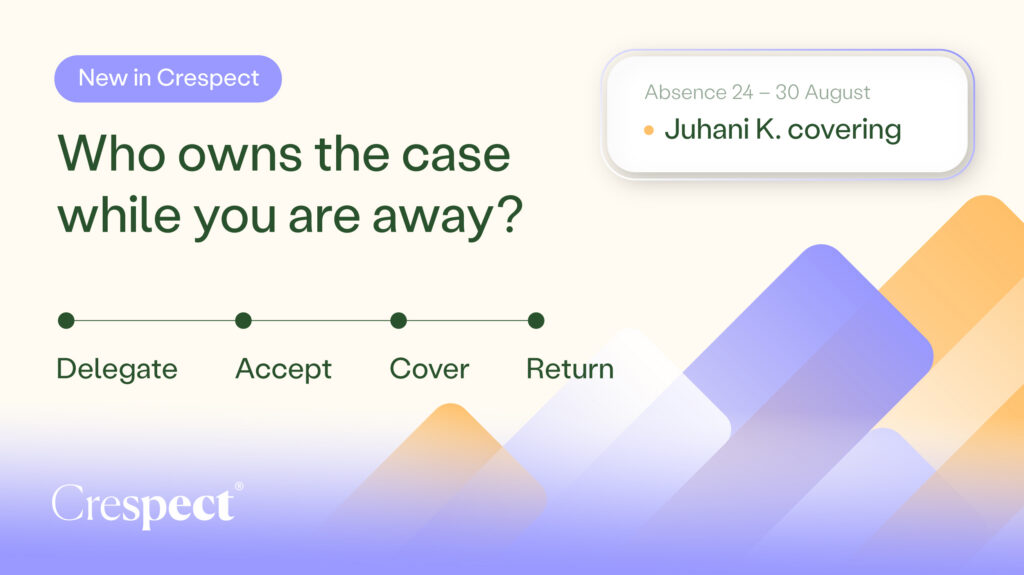
Delegations sits under Cases in Crespect, for absences you can plan: leave, holiday, secondment. Setting one up takes three steps. You pick your absence dates. You select the cases where you are Supervising Partner or Responsible Lawyer and assign a substitute per case and per role, with handover notes and a per case choice on whether invoice review transfers too. Then you review and confirm.
Then the part that makes it trustworthy: nothing moves yet. Each substitute takes on only the cases they agree to cover, declines come straight back to you with time to reassign, and if someone sits on the request Crespect reminds them before your absence starts. On day one, accepted covers activate on their own. Open tasks transfer, calendar involvement follows, and your name never leaves the case. The substitute is a temporary layer on top, not a replacement, and you can swap one mid absence if plans change.
Coming back is where it pays off twice. You reclaim your cases with one click, early if you like, and if you forget entirely the system returns everything shortly after your planned end date. Then each substitute writes a return note on every case they covered: what happened, what moved, what needs you. Your first morning back is a read, not an investigation. One smaller thing lawyers appreciate: before you delegate, Crespect points out cases that look ready to close, so your substitute can inherit a clean desk instead of an archive.
Why we built it
Katri-Helen Wojtkowiak, who leads product at Crespect, describes the goal in plainer terms:
Lawyers kept telling us the same thing: the hardest part of a vacation is not the work before it, it is not knowing what happens to your cases while you are away. So we made handover something the system does properly: with consent, in the open, and fully reversible. My hope is simple. Lawyers on Crespect should actually switch off.
The point
A vacation should be a date range, not a risk assessment. With a proper handover mechanism, it is: cases covered by people who said yes, visible to everyone, returned to you with a written account of what happened. Rest stops depending on how well you happened to organise the week before you left.
If you are not using Crespect yet, this is a good moment to see the platform in a demo.